Changing jobs in Dubai is rarely a simple handover. In most cities, a career move means updating your CV, handing in your notice, and showing up somewhere new a few weeks later. In Dubai, the same transition often comes with a visa change, a potential address change, a gap between roles that may stretch longer than expected, and a collection of work equipment sitting in your home that suddenly has no clear place to be.
This last part is the one nobody talks about. But for professionals who have built out a home office, accumulated work-related equipment over several years, or are navigating the uncertainty of what the next role will actually require, the physical dimension of a job change can become genuinely complicated.
The Dubai Career Transition Is Different

A few things make job changes in Dubai more physically complex than they might be elsewhere.
The first is the visa timeline. When you leave an employer in Dubai, your visa situation changes. Depending on your circumstances, you may be on a grace period, in the process of transferring sponsorship, or planning a brief trip home while the next role is confirmed. Any of these scenarios can mean a period of genuine uncertainty about where you are living, for how long, and in what configuration.
The second is the prevalence of home office setups. Dubai’s professional community adapted significantly to remote and hybrid work over recent years. Many professionals have invested in proper home office furniture, multiple monitors, ergonomic chairs, high-quality peripherals, and dedicated workspace equipment. When a job changes, particularly if the new role has different requirements or a different working arrangement, that setup may no longer make sense in its current form.
The third is the possibility of relocation. Not every job change in Dubai stays in Dubai. A new role might involve a move to another emirate, a period working from a different city, or even an international move that has not yet been fully confirmed. During that uncertain in-between period, a home full of professional equipment needs somewhere sensible to be.
The Three Scenarios Most Professionals Face
It helps to be specific about which situation you are actually in, because the storage approach differs meaningfully between them.
The first scenario is a clean transition with a short gap. You have a new role confirmed, your start date is two to four weeks away, and the main challenge is managing equipment that your current employer owns versus equipment that is yours. Company laptops, phones, and accessories need to go back. Your personal monitor, desk chair, keyboard, and peripherals stay with you, but they may need to be temporarily reorganized or stored if you are moving apartments during the gap.
The second scenario is an extended gap with uncertainty. The next role is not yet confirmed, or you are taking deliberate time between positions. Your home office setup is in limbo. You may be considering downsizing your apartment during this period to reduce costs, which creates an immediate need for somewhere to put professional equipment that you are not actively using but will definitely need again.
The third scenario is a transition that involves relocation. You are leaving Dubai temporarily or permanently, or moving within the UAE, and you need a plan for everything in your home, not just the work equipment. This is where expat storage becomes the most practical tool available, a secure base for your belongings while the larger picture becomes clearer.
What Actually Needs Managing During a Job Change
Let us be specific about the categories of equipment most professionals need to think about.
Company-owned equipment is straightforward. It goes back to the employer, ideally in the same condition it arrived. If you are working from home and the company provided equipment, factor the return logistics into your transition timeline. Do not leave this until the last day.
Personal work equipment is where decisions get more complex. Items in this category typically include:
- Personal laptops and tablets
- External monitors and stands
- Ergonomic chairs and desk setups
- Keyboards, mice, and peripheral devices
- Webcams, microphones, and lighting for video calls
- Printers, scanners, and document equipment
- Storage drives and backup hardware
- Professional reference books, binders, and printed materials
If your next role involves full-time office attendance, much of this equipment loses its daily purpose immediately. Storing it properly rather than leaving it to gather dust in a spare room, or making rushed decisions to sell it before you know whether you will need it, is the more sensible approach.
Short-term storage gives you the breathing room to make those decisions well rather than under the pressure of a transition.
The Home Office Furniture Question
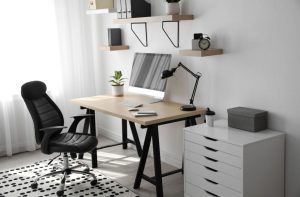
This deserves its own section because it comes up so consistently. Many professionals in Dubai invested significantly in home office furniture during the shift to remote work. Proper desks, quality ergonomic chairs, monitor arms, shelving, and dedicated workspace furniture are not cheap, and they are not easy to move around.
When a job change removes the daily need for a home office setup, this furniture becomes awkward. It is too valuable to casually discard. It takes up significant floor space in an apartment where that space could be used for other purposes. And it represents a decision that does not need to be made immediately but does need to be made eventually.
The practical interim solution is furniture storage. Move the home office furniture offsite while the new role settles in and the working arrangement becomes clear. If the new job turns out to require a home setup again, retrieve it. If not, you have the time and mental space to decide what to do with it without the furniture cluttering your living space in the meantime.
Managing Electronics in Dubai’s Climate
One detail that matters more than most people realize: electronics stored incorrectly in Dubai do not always survive the experience intact.
Monitors, laptops, external drives, and professional audio or video equipment are all sensitive to heat and humidity. Leaving them in a storage cupboard, a garage, or any space without proper climate management over a Dubai summer is a risk that is easy to avoid and unnecessary to take.
Climate-controlled storage maintains the stable conditions that electronics need. Temperature and humidity levels stay consistent, which means the equipment you retrieve after a few months of storage works exactly as it did when you put it in.
For professionals with high-value equipment, this is simply good asset management.
The Career Transition Storage Framework
Here is a practical way to approach the equipment question during a job change, broken into three phases.
Phase one is the exit audit. Before your last day in the current role, create a clear list of everything in your possession. Separate company equipment from personal equipment. Confirm return arrangements for anything that belongs to the employer. Do not let this become confused or rushed.
Phase two is the gap configuration. Identify what you will actively use during the gap period, a personal laptop for job searching, a phone, basic productivity tools, and set those aside. Everything else, the full desk setup, the peripheral equipment, the professional materials, moves into temporary storage. Your living space stays functional and clear-headed during what is already a mentally demanding period.
Phase three is the new role setup. Once the new role is confirmed and the working arrangement is clear, retrieve what you need and configure accordingly. If the new role is fully office-based, some equipment may stay in storage long-term or be sold. If it involves any remote working, retrieve and set up thoughtfully rather than reactively.
This phased approach prevents the common pattern of making poor decisions about equipment in the rushed final days of one role, only to regret them when the next role has different requirements.
Quick Wins During a Job Transition
If you are mid-transition and want immediate practical progress:
- Separate all company equipment from personal equipment today, before any confusion arises about what belongs to whom.
- Identify the three or four items you will definitely use during the gap and set them aside. Everything else is a storage candidate.
- Do not sell specialist equipment during a transition unless you are absolutely certain the next role will not require it.
- If you are moving apartments during the gap, coordinate the storage move and the apartment move together rather than managing them separately.
- Label everything clearly before it goes into storage. A monitor that goes in labelled is a monitor you can find and retrieve without a search session three months later.
For Professionals Between Roles in Dubai

Dubai is a city where professional transitions happen frequently and sometimes quickly. The job market moves fast, opportunities arise unexpectedly, and the gap between roles does not always follow a neat timeline.
For professionals navigating that gap, whether it is two weeks or six months, having a clear plan for work equipment removes one category of stress from what is already a period of significant change.
Families managing a job transition alongside a school year, a lease renewal, or a potential relocation will find that storage solutions in Jumeirah and similar residential communities are well placed to support the broader transition, not just the equipment question.
If you are in the middle of a career change in Dubai and want a practical conversation about the right storage arrangement for your situation, contact our team and we will help you find a setup that fits your timeline and your budget.
The job change is the main event. The equipment question is just logistics. Sort the logistics early and give yourself one less thing to think about.