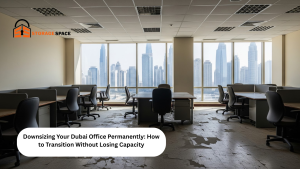
The decision to reduce office space permanently is different from a summer audit. A summer audit asks what you can move off-site temporarily. A permanent downsize asks what the business actually needs to function, every day, for the foreseeable future. That is a harder question, and most businesses in Dubai delay it longer than they should.
The reason for the delay is understandable. Office space carries meaning beyond its practical function. A larger footprint signals stability, capacity, and ambition to clients, to staff, and to the business itself. Letting it go feels like a concession, even when the numbers make the case plainly.
According to West Gate Real Estate, office rent in Dubai ranges from AED 80 per sq ft in secondary districts to over AED 450 per sq ft in prime free zones like DIFC. At those rates, every square metre occupied by surplus furniture, dormant equipment, or archived documents that could be held off-site is generating a real monthly cost with no operational return. The question is not whether to optimise it is how to do so without reducing what the business can actually do.
What permanent downsizing actually means
A permanent office downsize is not the same as moving to a smaller unit and hoping everything fits. Done properly, it is a structured reduction in the physical footprint of the business, with every displaced asset either removed, rehomed, or transferred to accessible off-site storage. The office that remains should be lean, functional, and suited to the way the team actually works not the way it worked three years ago.
For many Dubai businesses, the gap between those two versions of the office is significant. Hybrid working has changed how much time staff spend on-site. Headcount changes have left surplus workstations. Fit-outs designed for pre-pandemic working patterns now carry furniture and infrastructure for roles that no longer exist in the same form.
The opportunity in a permanent downsize is to close that gap and capture the savings it represents, without sacrificing the ability to work at full capacity when it matters.
The assets that make downsizing feel impossible
The practical obstacle most businesses encounter when considering a permanent office reduction is not the lease it is the contents. A smaller office unit cannot hold everything the current space contains. The furniture, the document holdings, the equipment, the collateral and event materials: all of it needs a decision, and most of it gets deferred because disposal feels premature and the current lease still has time to run.
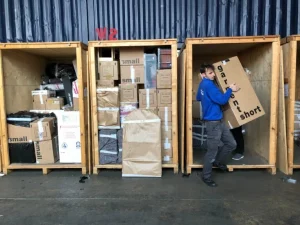
Office furniture storage provides the release valve that makes a downsize practically possible. Desks, chairs, shelving, and meeting room furniture that exceed the new unit’s capacity do not need to be disposed of immediately. Moving them off-site preserves optionality the business can right-size again as it grows, without the cost and lead time of purchasing new fit-out while freeing the current space to function at its correct scale.
The same logic applies to documents. Physical records that are retained for compliance do not belong in a smaller, premium-rate office unit. Document archive storage holds them accessibly and securely, at a cost per cubic metre that is a fraction of what prime commercial space charges for the equivalent floor area.
The Capacity Separation Model
This post introduces a framework for approaching a permanent office downsize without conflating two things that should be kept distinct: the capacity the business needs operationally, and the physical footprint required to maintain it.
The Capacity Separation Model works by mapping each category of office asset to the location it actually belongs in not where it currently sits by default.
Active workstations belong on-site. The number needed is the peak concurrent headcount, not the total headcount. A team of twenty where eight work hybrid at any given time needs eight to ten workstations, not twenty.
Meeting and collaboration infrastructure belongs on-site, but at the scale of actual usage. A boardroom that seats twelve, used twice a month at capacity, does not justify its floor space in a downsized unit. A flexible meeting room that seats six and doubles as a focus space earns its place.
Furniture reserves belong off-site. Any piece of furniture not in weekly use spare chairs, a second boardroom table, storage units from previous configurations — occupies paid space without a return. Storage resolves this without a disposal decision.
Document holdings belong off-site, categorised by access frequency. Anything not needed within forty-eight hours can leave the office floor entirely.
IT equipment in active use belongs on-site. Legacy devices, spare hardware, and equipment awaiting a replacement decision belong off-site in a managed facility, not in a server cupboard or storage room that is consuming office square footage.
Running this model before signing a new, smaller lease gives the business a clear view of what the new unit needs to contain and confirms whether the proposed size is genuinely workable before the commitment is made.
Why summer is the right moment to decide

July in Dubai is when the pace of business slows enough to think clearly. Key decision-makers are accessible. Fewer urgent demands compete for attention. And the office itself, running at reduced capacity through the summer months, makes it easier to assess what the team actually needs versus what is simply present by habit.
A business that completes a Capacity Separation audit in July and July is well-positioned to act on a lease decision in Q3, before the market reactivates fully in September and the pressure of a busy Q4 makes strategic decisions harder to prioritise.
What the transition needs to work
A permanent downsize that is executed cleanly requires a few things to be in place before the move happens:
- A clear inventory of what is leaving the current unit and where each item is going.
- Off-site storage booked in advance of the move date, not arranged reactively once the new unit is occupied.
- A decision on document holdings: what is digitised, what is archived off-site, and what is legitimately discarded.
- A furniture plan for the new unit that reflects actual usage, not the layout of the space being left.
- Access to long-term business storage for assets that are retained but not needed on-site.
Businesses in TECOM, JLT, or along Sheikh Zayed Road offices that have been considering a permanent reduction in footprint will find that the practical obstacle — what to do with everything that does not fit the smaller unit has a straightforward solution. If you want to talk through the options before a lease decision is made, request a quote and the team can help you plan the transition properly.