The outdoor events calendar in Dubai runs hard from October through April. Festivals, brand activations, community markets, corporate evenings, sporting events, product launches under the stars. Then June arrives, and it stops almost entirely.
This is not a slow period. It is a full halt. And for companies whose entire operation depends on physical assets, tents, staging, rigging, AV equipment, furniture, branded structures, the off-season is not downtime. It is one of the most operationally consequential periods of the year.
What happens to those assets between May and September determines whether the company re-enters the October season at full capacity or spends the first two months recovering from preventable damage.
The scale of the problem is easy to underestimate
An outdoor event company in Dubai might have tens of thousands of dirhams worth of equipment that simply has nowhere to go when the season ends. Warehouses tied to production facilities are often too expensive to justify year-round. Office space is not appropriate. Leaving assets on a site, in a yard, or stacked in a car park is common but costly.
Dubai summers are not merely inconvenient for outdoor equipment. They are genuinely destructive. Temperatures in direct sun regularly exceed 60 degrees Celsius on exposed surfaces. UV degradation on fabric and plastics is severe. Steel and aluminium structures that are not properly stored can pit, corrode, or warp. Electrical components in AV or lighting rigs are particularly vulnerable to sustained heat exposure without any climate management.
Companies that treat the off-season as a storage problem to solve quickly tend to re-enter the season with diminished inventory. Companies that plan for it deliberately tend to re-enter stronger than they left.
What outdoor event assets actually need in storage
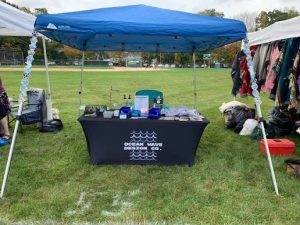
Not all assets carry the same risk profile, and understanding that distinction shapes a smarter storage approach.
Fabric structures, including stretch tents, branded canopies, marquees, and shade sails, are among the most vulnerable assets in any outdoor event inventory. Stored improperly, especially folded and left in heat, they develop permanent creases, UV yellowing, and mildew along seams. Clean, dry, loosely packed storage in a climate-managed environment extends their lifespan considerably.
Staging, trussing, and structural components are generally more forgiving, but they still benefit from being off the ground, covered, and stored away from direct sun exposure. Corrosion on connectors and joints is a common issue when metal components are left outside or in poorly ventilated spaces through a humid summer.
AV equipment, lighting rigs, and sound systems need climate-controlled storage without question. Circuit boards, cable insulation, and speaker components all degrade when exposed to sustained heat over months. A single failed component in a lighting rig can cost more to replace than several months of proper storage.
Furniture, whether it is the company’s own event furniture inventory or client pieces in transit between events, requires dry conditions and stacking arrangements that prevent pressure damage to upholstery and frames.
The Asset Tiering Model
Before moving anything into storage, the most useful exercise an outdoor event company can do is tier its inventory by sensitivity and replacement cost. This creates a cleaner, more cost-efficient storage strategy rather than treating everything as equally urgent.
The model works across three tiers:
- Tier 1 — Climate-sensitive and high-value: AV equipment, lighting and sound systems, branded fabric structures, anything with electronics or precision components. These go into climate-controlled, enclosed storage as a non-negotiable.
- Tier 2 — Durable but condition-sensitive: Staging, trussing, modular furniture, branded signage frames, generator housing. These need protection from direct sun, dust, and moisture but do not require the same level of climate management as Tier 1.
- Tier 3 — Hardy and replaceable: Basic groundwork materials, generic cable management, expendable consumables. These can tolerate more basic storage conditions, freeing budget for the assets that genuinely need better protection.
Running inventory through this filter before the season ends tells you exactly how much climate-controlled space you need versus standard space, which directly affects cost. Most companies that have never done this exercise find they have been over-spending on storing low-sensitivity items in premium conditions, or under-protecting high-value assets in inadequate ones.
Documentation as part of the storage process

The off-season is also the right time to conduct a proper asset audit. When equipment is being packed down after the last event of the season, condition should be logged against each item before it goes into storage. This creates a clear baseline for what comes back out in September.
Without that documentation, disputes about when damage occurred become impossible to resolve. Insurance claims become harder to substantiate. And the cost of deterioration gets absorbed silently rather than tracked against the right cause.
Commercial storage that includes structured intake, clearly labelled units, and organised racking makes this audit process far more manageable. Assets that go in with a reference system come back out in September without the chaos of an unlabelled pile.
What the October re-entry actually looks like
Event companies that plan their off-season storage well tend to share one common characteristic: they can quote and confirm October bookings in August without hesitation, because they already know what inventory they have, what condition it is in, and when it will be accessible.
Companies that do not plan for this tend to spend the first weeks of October in a recovery mode. Equipment checks, last-minute repairs, replacements for items that did not survive the summer. That delay has a direct commercial cost, especially in a market where the October calendar fills fast and clients are not inclined to wait.
For event and exhibition businesses operating in and around the World Trade Centre district, event and exhibition storage designed for the specific demands of this industry makes the transition in and out of season significantly cleaner.
Practical steps for a structured off-season handover
The period between the last event of the season and the moment assets go into storage is where most of the value is created or lost.
- Conduct a full condition audit at pack-down, not weeks later when memory fades
- Clean all fabric structures before storage, never store them damp or soiled
- Label every crate, case, and component with contents and condition notes
- Photograph high-value items before they go into storage
- Separate items requiring repair so they can be addressed before October, not discovered after
- Book storage capacity in advance, not in the last week of June when availability tightens
Companies that treat the off-season handover as a formal process rather than a rush job consistently re-enter the season in better shape. The discipline required is not significant. The commercial difference is.
Storage capacity as a competitive advantage
There is a version of this that goes beyond asset protection. Outdoor event companies with reliable, well-organised off-season storage have a structural advantage over those that do not. They can hold more inventory, maintain larger fabric structure libraries, and offer clients a broader range of assets because they are not constrained by what can survive a summer in inadequate conditions.
In a competitive market like Dubai’s events industry, operational reliability is a differentiator. Clients notice when a company arrives in October fully equipped versus scrambling.
For outdoor event companies looking to plan their off-season asset storage before the summer cutoff, the team at Storage Space can advise on unit configuration, climate options, and flexible short-term business storage arrangements that match the seasonal nature of the work. Get in touch to discuss what your inventory needs before the season closes.