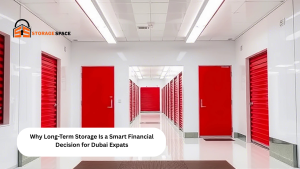
The office did not disappear. It just stopped being the only place where work happens.
For businesses operating in Dubai, the shift to hybrid working has been one of the most consequential changes of the past several years, not just for how teams operate, but for how much physical space they actually need, and what they do with everything that used to fill it.
The storage implications are significant and, for many companies, still unresolved.
What hybrid working actually changed about office space
When teams split their time between home and office, the logic of the traditional office layout stops making sense. Dedicated desks for every employee become an expensive use of floor space when a large share of the team is out on any given day. Meeting rooms designed for full attendance sit half-empty. Storage built for a five-day-a-week workforce holds more than the current headcount requires.

According to Khaleej Times, LinkedIn’s Economic Graph report for early 2025 showed hybrid job postings in the UAE rising nearly 84% year-on-year, the highest growth rate across the entire Europe, Middle East, Africa, and Latin America region. That figure reflects a structural shift rather than a temporary experiment. Businesses that responded by rightsizing their office footprint are now dealing with a practical question that nobody planned for: what happens to the furniture, equipment, and assets that no longer fit the new layout?
Activity-based working, now the most commonly specified office approach in Dubai corporate fit-outs, typically achieves a 20 to 30% reduction in total workstations relative to headcount. For a team of 40, that can mean clearing out ten to fifteen desks, the chairs, pedestals, and equipment that went with them, and finding somewhere for all of it to go.
The Asset Displacement Problem
Most businesses approach a hybrid transition as a workspace planning exercise. They redesign the floor, add collaboration zones, reduce fixed desks, and install booking systems. What they often do not plan for is the physical inventory that the redesign displaces.
This is what might be called the Asset Displacement Problem. It describes the gap between the assets a business owns and the space it now has available to hold them. Hybrid working created that gap for thousands of Dubai businesses, and many resolved it poorly, stacking surplus furniture in back offices, distributing equipment across employees’ homes, or writing off items that still had years of useful life.
The businesses that handled it well treated displaced assets as a storage decision rather than a disposal decision. Moving surplus desks, chairs, and equipment into off-site furniture storage gave them the flexibility to retrieve, redistribute, or sell those items on their own timeline, rather than making permanent decisions under time pressure.
What typically gets displaced in a hybrid transition
The categories that come up most often for businesses rightsizing in Dubai are:
- Surplus desks, chairs, and pedestals from positions that no longer have assigned occupants
- Conference room furniture from meeting rooms converted to collaboration spaces or reduced in capacity
- IT equipment belonging to employees who have moved to fully remote arrangements, including monitors, docking stations, and peripherals
- Filing cabinets and physical document storage from offices shifting to digital workflows
- Branded materials, display equipment, and reception furniture from receptions reduced in scale
None of this is worthless. Most of it is still serviceable. The problem is that hybrid office layouts simply do not have room for it, and businesses operating from DIFC, Business Bay, or JLT are paying premium per-square-foot rates for space they cannot afford to fill with things they are not currently using.
The home office variable
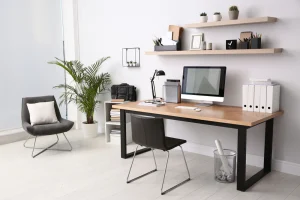
Hybrid working did not just change the office. It changed employees’ homes. Companies that provisioned staff with monitors, chairs, standing desks, and peripheral equipment during the shift to remote work now face a retrieval question as those employees move on, return to the office, or restructure their home setups.
Equipment distributed across a workforce needs to go somewhere when it comes back. A company without centralised storage ends up with an informal, untracked inventory scattered across apartments from Dubai Marina to Al Barsha. Businesses that have been through this recognise that a single dedicated storage unit for distributed equipment creates a proper retrieval and redistribution system rather than a collection problem managed over WhatsApp.
Document and record storage as a hybrid consequence
One category that hybrid working accelerated significantly is document storage. As teams reduced their physical office footprint, the paper files, binders, and archived records that previously occupied dedicated filing rooms had to go somewhere.
Some businesses digitised. Most digitised partially and still hold physical records that carry regulatory or operational value. Moving those records off-site frees the remaining workspace for what hybrid teams actually need: collaboration areas, meeting rooms, and flexible working zones. For businesses with compliance obligations around record retention, secure document storage off-site is also a cleaner operational arrangement than files stacked in a cupboard that the cleaning team keeps reorganising.
Seasonal and project-based demand
One dimension of hybrid work that gets less attention is the variation in team presence across the year. Dubai’s business calendar creates natural troughs, particularly through the summer months, when a significant portion of the workforce is abroad and office attendance drops further. Businesses paying for storage within their leased office space pay the same rate whether the space is in active use or not.
Keeping surplus assets in a dedicated off-site unit through the quieter months, then retrieving what the team needs ahead of the September return, gives businesses a more rational approach to physical capacity than trying to absorb everything within a fixed lease footprint.
Planning storage as part of workspace strategy
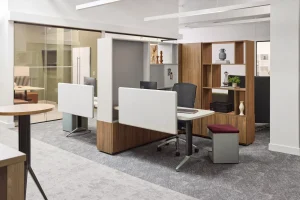
The businesses managing this well in Dubai are not treating storage as an afterthought to the hybrid transition. They are treating it as a component of workspace strategy from the start, alongside the desk booking system, the collaboration tools, and the floor plan redesign.
That means auditing what the business owns before a transition, identifying what will have no physical home in the new layout, and putting a proper off-site arrangement in place before the surplus accumulates. The alternative produces an inconsistent, untracked inventory with no clear path to retrieval or reuse.
Companies that have been through this process typically find the storage decision simpler than the workspace redesign itself. The assets are known, the categories are clear, and the volume is finite. What it requires is a deliberate decision to treat the physical inventory as seriously as the floor plan, rather than leaving it to be sorted out after the fact. The business storage options at Storage Space are built around exactly this kind of operational need, and the team can help you work out the right approach for your size and timeline.